















































Centre Deploys Expert Team as Chandipura Virus Outbreak Spreads in Gujarat and Rajasthan
The Centre has deployed an expert team to Gujarat and Rajasthan as Chandipura virus cases rise and scientists investigate its spread.

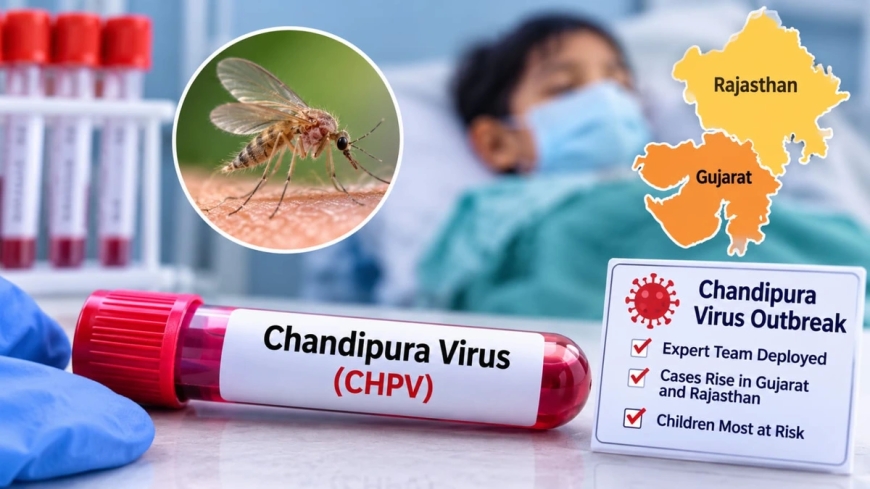
The Central government has intensified its response to the Chandipura virus outbreak by sending a high-level expert team to Gujarat and Rajasthan. The move comes after a rise in infections among children, with Gujarat reporting multiple deaths during the ongoing monsoon season.
Health authorities are also carrying out an extensive scientific investigation to better understand how the virus is spreading and whether it has undergone any genetic changes.
Gujarat Reports 35 Confirmed Cases, 22 Child Deaths
According to government data, Gujarat has confirmed 35 Chandipura virus infections after testing 184 suspected cases. The outbreak has claimed the lives of 22 children under the age of 15, making it one of the most serious outbreaks recorded in recent years.
Neighbouring Rajasthan has also reported three confirmed cases from the border districts of Dungarpur and Sirohi. All three infected children were shifted to Gujarat for specialised treatment, but two of them later died.
National Outbreak Response Team Deployed
To strengthen the response, the Union Health Ministry has deployed a National Joint Outbreak Response Team (NJORT) to support state governments.
The team includes specialists from the National Centre for Disease Control (NCDC), the Indian Council of Medical Research (ICMR) and the Department of Animal Husbandry and Dairying (DAHD).
These experts will assist state authorities with outbreak investigations, disease surveillance, laboratory coordination, patient management, vector monitoring and containment measures. The NCDC Public Health Emergency Operations Centre has also been activated to coordinate field operations.
What Is Chandipura Virus?
Chandipura virus (CHPV) is a vector-borne virus that mainly affects children below the age of 15.
The infection usually begins with a sudden high fever but can rapidly progress to Acute Encephalitis Syndrome (AES), a serious condition that causes brain inflammation and seizures. Health experts estimate that the virus has a fatality rate of 55% to 75%, making early diagnosis and treatment extremely important.
Scientists Expand Investigation Into the Outbreak
Alongside emergency response efforts, researchers have launched a large-scale scientific study to understand the current outbreak.
Experts are conducting active surveillance among patients with acute febrile illness (AFI) and Acute Encephalitis Syndrome (AES). Community-based serological surveys are also being carried out to determine how widely the virus may have spread.
Researchers Study Virus Transmission
Although infected sandflies are considered the primary carriers of Chandipura virus, scientists are investigating whether other insects such as mosquitoes, ticks and mites could also contribute to transmission.
At the same time, surveillance has expanded to livestock. Researchers are collecting blood and milk samples from animals to examine whether the virus is circulating beyond human populations.
The Health Ministry said it would be premature to identify additional vectors until scientific studies are completed.
Genome Sequencing Underway
Scientists are also examining whether the virus has changed genetically.
Clinical samples are currently undergoing whole-genome sequencing at the Gujarat Biotechnology Research Centre (GBRC) in Gandhinagar.
According to the Health Ministry, preliminary analysis has detected minor genetic variations. However, experts said further comparative studies are needed before determining whether the current virus strain differs significantly from those responsible for previous outbreaks.
Experts Stress Prevention and Early Detection
Medical experts say early identification of symptoms remains the best way to reduce fatalities.
Dr Aashish Chaudhry, Managing Director of Aakash Healthcare, said rapid diagnosis, trained frontline healthcare workers, stronger disease surveillance and public awareness are essential because Chandipura virus progresses quickly.
He also emphasised the need for sustained vector control measures, better environmental sanitation and coordinated public health action to reduce the risk of future outbreaks.
Government Continues Nationwide Surveillance
The Centre has expanded surveillance through a nationwide network of hospitals that monitor Acute Encephalitis Syndrome cases.
Officials said the response follows a One Health approach, bringing together experts from human health, animal health and vector surveillance to better understand and contain the outbreak.
The government has maintained that protecting children and preventing further transmission remain its top priorities as investigations continue.
What's Your Reaction?